Highlights
- AI creates most value when it starts with a commercial challenge, and the biggest prize is new products, services and revenue streams, not just productivity gains.
- Strong data, governance and cybersecurity foundations, together with CEOs who lead by example, determine how much of that value a business can capture.
- Inflexion’s value acceleration team works alongside management across strategy, talent and technology, drawing on the Inflexion Ignite network and major tech partners.
At Inflexion, value acceleration means working alongside management teams to turn ambition into long term growth. Across the mid-market, AI is a powerful lever to help drive this growth.
But technology alone is never the answer. The greatest impact comes when AI is connected to clear commercial priorities and is supported by robust data, governance and operational foundations. In this discussion, our value acceleration experts share perspectives on where AI is creating value today, and how management teams can move from experimentation to lasting competitive advantage.
Inflexion’s dedicated value acceleration experts Alex Mathers, Mike Arshinskiy and Jan Beitner discuss how mid-market businesses can turn AI into lasting growth.
As agentic AI continues to accelerate, what does this mean for mid-market businesses?
Alex: 2026 has seen an inflection point in AI capability, but our fundamental perspective remains the same in terms of looking at technology as a ‘how’, not as a ‘what’. Businesses should start with the commercial challenge they are trying to solve – rather than pursuing AI purely for its own sake. Whether the focus is improving the go-to-market strategy, accelerating product development or delivering services more effectively, AI is a powerful method of achieving those outcomes – often faster and more efficiently than was previously possible.
But the opportunity runs wider than doing existing things better. While many businesses are naturally focusing on productivity gains, the bigger prize lies in what AI newly makes viable: using it to create entirely new products, services and revenue streams that simply weren’t on the table before.
The businesses that benefit most will be those with strong fundamentals already in place – good data infrastructure, robust information management, cybersecurity and governance. AI builds on those capabilities rather than replacing them – and the stronger the foundations, the more of this new opportunity a business can capture.
While many businesses are naturally focusing on productivity gains, the bigger prize lies in what AI newly makes viable: using it to create entirely new products, services and revenue streams that simply weren’t on the table before.
Everyone’s talking about AI strategy – how do you think about it?
Alex: For us, AI is always considered as part of a broader value creation plan. Our objective remains the same since inception: helping businesses become larger, faster-growing and higher-margin. AI can help enable and accelerate those outcomes.
AI delivers its full potential when businesses rethink how they operate rather than simply targeting individual processes. The biggest gains come from asking the bigger questions: can we redesign service delivery? Can we create an entirely new offering? That’s where leadership becomes so important.
Jan: AI allows companies to explore opportunities they may never previously have considered. We often start by helping companies map workflows from marketing and sales to in-product workflows and service delivery that have not already been documented. It’s a valuable exercise that can highlight opportunities for automation while also revealing where businesses can reinvent processes altogether or launch products or services that weren’t possible before.
Mike: We typically see three areas where AI is creating value. Firstly, for our businesses building software, there is engineering efficiency, where we encourage teams to be more productive year on year. This then enables them to allocate the resulting extra capacity either into reducing technology debt, cost optimisation or developing new products. The second is embedding AI directly into customer products, creating stronger commercial propositions – with Curinos’ new AI enabled platform a good example. And then there is back-office optimisation, from administrative processes through to go-to-market activities, where AI can improve both efficiency and customer experience.
Why is it important for leadership teams to get hands-on with generative AI?
Alex: First-hand experience is vital to really understand what is possible for their businesses – or what competitors might be able to do with AI. Whether you’re thinking about pricing, product development or customer engagement, it really changes your perspective.
Jan: We’ve already talked about the need for rethinking how a business works to get the maximum benefit from AI long term. If AI is only seen as a technology initiative, that will be a struggle. CEOs need to lead by example, helping colleagues understand how AI can improve their own areas of responsibility.
How does Inflexion help portfolio companies capture the AI opportunity?
Alex: AI touches data, systems, cybersecurity, commercial strategy, talent, M&A and governance, so our dedicated value acceleration team works alongside management teams across all of these disciplines. This is very much a cross-disciplinary approach – not just about the technology. Our sizeable portfolio also learns a lot from each other, connecting at Inflexion events to share experiences and expertise.
Mike: The specialist AI and data talent this requires is scarce and not something most mid-market businesses have had reason to hire before. We help strengthen leadership teams by recruiting specialist talent, coaching existing executives and filling knowledge gaps, drawing on the Inflexion Ignite network, a global network of trusted value creation specialists.
Inflexion also works closely with major tech providers and implementation partners, giving our portfolio access to expertise and commercial benefits that would otherwise be difficult to obtain for a mid-market company.
Ultimately, success is measured by business outcomes rather than just AI adoption. If 2026 has been about AI adoption, 2027 will be about measuring impact. And that’s our focus at Inflexion – helping portfolio companies manage AI carefully and maximise their investment.
Inflexion Point Podcast
‘Rethinking AI as a superhuman, not software’ with Greg Nieuwenhuys
Inflexion Point turns to AI, and why the businesses that thrive will be those whose leaders learn to work differently, not those that buy the most software. Host Tim Smallbone is joined by Greg Nieuwenhuys, chair of Nodor and a former AI sceptic, and Alex Mathers, the Inflexion partner who heads Value Acceleration. They discuss why culture, not technology, is the real barrier, why the CEO must own adoption, and the one thing a leader who feels behind could do this week.

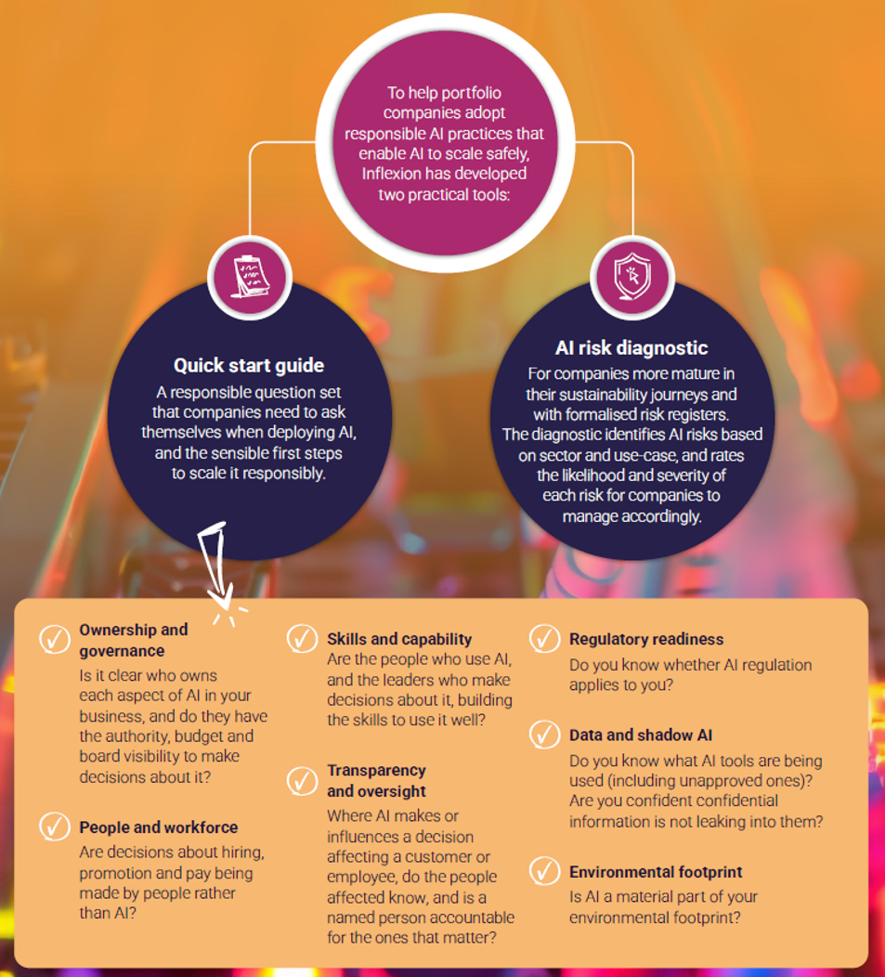
Clear governance helps accelerate AI adoption
As AI adoption accelerates, clear ownership and governance are essential to ensure initiatives are deployed responsibly, scaled effectively and deliver measurable business value.
For most businesses the real AI risk isn’t any single use case, it’s the gap between how fast employees adopt it and how slowly the business puts a governance structure around it. Close that gap and AI becomes even more valuable.