

Highlights
-
In 2025, Inflexion opened its first office outside Europe. The nine-person team, based in New York, was built primarily to help portfolio companies accelerate their North American growth through acquisitions.
-
Inflexion took a deliberate approach to establishing its New York presence, building a nine-person team that combines local US expertise with Inflexion experience from London.
-
Flor Kassai, Managing Partner, and Ben Meyer, Head of North America, explain why Inflexion made the move, how the team was built and share five lessons for businesses considering expansion into North America.
In 2025 Inflexion opened its first office outside Europe: a nine-person team in New York built primarily to help portfolio companies accelerate their North American growth through transformational acquisitions. The team also supports new UK and European investment opportunities where North American expansion is an important part of the growth plan.
Managing Partner and Head of Buyout Flor Kassai and Partner and Head of North America Ben Meyer discuss why Inflexion made the move, how the team was built and what it takes to establish a presence in the world’s most competitive private equity market.
The decision
What was the trigger for opening a US office?
Flor Kassai, Managing Partner, Inflexion: It wasn’t a generic desire to plant a flag in the US. We were hearing a consistent message from our portfolio company management teams and advisers across the UK and Europe: North America was becoming an increasingly important growth market and they wanted Inflexion alongside them as they pursued it.
That gave us a very clear starting point. We began with portfolio companies whose growth plans already pointed towards North America and where acquisitions were a natural next step. To create the initial group of priority companies, we considered a number of criteria including investment and exit timing, financial performance and, above all, how central North American expansion and M&A were to the value-creation plan.
How did this compare with Inflexion’s earlier expansions into Amsterdam, Stockholm and Frankfurt?
Flor: The principle was the same – being close to the people we back. But the nature of the expansion was different. Amsterdam, Stockholm and Frankfurt extended our presence within European markets we already knew well. North America meant entering a much larger, deeper and more competitive market, so we needed a very deliberate point of entry.
Rather than trying to recreate a US private equity firm from scratch, we built around a specific need we could already see among our portfolio companies. That meant putting people on the ground who could combine local North American networks and execution capability with the sector expertise and management relationships we had built over many years in Europe.
What gave you the confidence to commit?
Flor: Playing to our strengths. The US has extraordinary scale and talent, as well as meaningful legal and business common ground with the UK, but we respected its competitiveness from the outset.
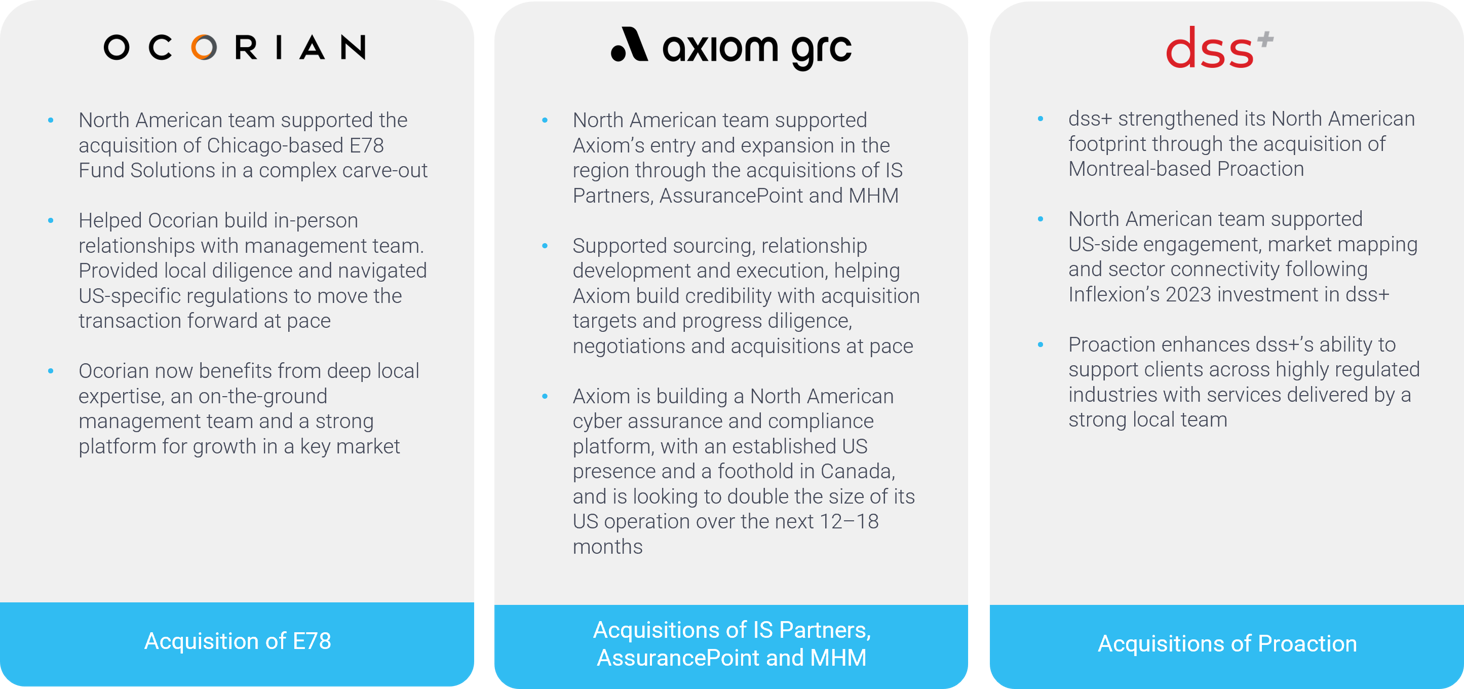
Rather than trying to do everything, we focused on a clear mandate. Our sector teams have accumulated deep knowledge over many years, which allows us to be a real thought partner to management. Combine that with people on the ground in North America and a focused mandate, you have something powerful. In our first 12 months, the team reviewed more than 140 opportunities, most of them squarely on mandate, and helped deliver several significant acquisitions, including E78 Fund Solutions for Ocorian and IS Partners for Axiom GRC.
That is what excites me – helping the companies we back become genuine transatlantic champions.
Supporting portfolio companies accelerate their North American market entry through strategic acquisitions
Building the team
Why take a deliberate, incremental approach?
Flor Kassai: I have always thought there is real wisdom in doing things in the right order. With something like this, the temptation can be to move quickly and show progress, but the foundations matter more than the pace. We wanted the office, the team and the relationships to be built properly, each one supporting the next, so that what we created would last rather than simply launch well.
Talent was central to that. I believe it is the single biggest driver of success in our business and you cannot build something meaningful with one or two people stretched thinly. We wanted a team with real depth, backed properly from the start and with the full support of the Partnership. Get the team right and so much of the rest follows.
Choosing who leads a market entry is critical, too. It is a really special role and quite a rare one. Ben was a natural fit. He had built US practices from the ground up before and understood how to establish a team and reputation in a new market while remaining closely connected to London.
Ben Meyer, Partner and Head of North America, Inflexion: We started by defining the Partnership’s objectives for North America and being realistic about our limitations. Those became the foundational inputs into everything else: our strategy, our go-to-market, the activity we wanted to support and, ultimately, the size and composition of the team.
We deliberately built the first phase around roughly three to three-and-a-half years, broadly matching our fund deployment cycle. That led to a nine-person team, six investment and three non-investment professionals, with enough capacity to execute more than one transaction at a time, build relationships in the market and support our portfolio companies properly, without creating pressure to pursue activity for its own sake.
Importantly, the commitment had to be real in practice, not just in principle. This wasn’t going to be a satellite office or a single-person experiment. It meant partner-level commitment, a permanent office, secondees from our UK office and the support of our HR, IT, legal, immigration and tax teams, alongside a shared understanding of what success looked like. That alignment gave us the credibility and infrastructure to move at pace while staying true to the mandate.
Today that infrastructure phase is complete. Our permanent Midtown office is open, the full team is in place and the foundations of our brand in the market are established. And the proof is in the trajectory and momentum: in 2026 with our infrastructure and team fully in place, we have evaluated over 245 opportunities, which is already more than our entire US activity last year (2025 was our first year of launch) and we have six live prioritized projects, three of which are in exclusivity with one of those targeted to sign in the next wo weeks.
What were you looking for in the team?
Ben: We deliberately combined local US hires with Inflexion secondees from London. The local team brings US market knowledge, adviser relationships and execution experience; the secondees bring Inflexion’s processes, culture and internal relationships.
Seven of the nine team members are local hires and two are London secondees. Importantly, two of the local hires also have prior experience with this sort of buildout – helping a non-US based investment firm successfully expand into the US. All combined, this allowed us to hit the ground running rather than spend a year finding our feet.
Building on the ground
Where has local presence mattered most?
Ben: Proximity is everything. Being in-market means being part of the deal flow, developing relationships early and being close at hand during execution.
Ocorian’s acquisition of E78 Fund Solutions is a good example. The New York team could build the management relationship face-to-face, navigate US-specific legal and transaction issues and bring a genuinely local perspective, while remaining fully joined up with the UK team.
Another example is Axiom’s IS Partners acquisition. Our US team has developed a close relationship with the IS Partners leadership team, who are based in Philadelphia, which is only a 60 minute train ride from our NYC Inflexion office. And, currently, we are actively working with them on several strategic projects to help further expand & grow their North American presence.
That combination is powerful – people on the ground who understand the US market, backed by colleagues who already know the portfolio company and its sector inside out.
How do New York and London work together?
Ben: Very closely. We run regular pipeline reviews, align early on what portfolio companies are looking for and work jointly on live acquisitions.
The New York team contributes proximity and North American execution capability; the wider firm contributes deep sector knowledge and the existing relationship with management. Neither works as effectively without the other.
Standing out
How have you built a reputation in such a crowded market?
Ben: I think it came down to four things: focus, depth of knowledge, being genuine in how we work with people, and showing that we were serious about the market from day one.
Rather than trying to introduce Inflexion to the whole US market at once, we concentrated on the sectors and companies where our portfolio had a real reason to be in North America. That meant we could bring deep sector knowledge and content to conversations – we understood the businesses, the markets they operated in and what they were trying to achieve strategically.
We also wanted people to experience how we work. We are straightforward, good to work with and, importantly, to stand behind what we say. That matters when you are building relationships in a new market, in particular in the US, and asking people to trust that you will deliver.
And we backed that up with real commitment. We didn’t simply plant a flag: we established the office with nine people from the outset, alongside specific portfolio companies, sector priorities and acquisition ambitions. That demonstrated a seriousness of intent about building a lasting presence in North America.
The progress has been encouraging. We went from seeing around ten opportunities a month in our first year to roughly 30 today, most closely aligned with our mandate. Increasingly, advisers are bringing us specific, targeted situations rather than broad processes, which suggests the market is beginning to understand both where we fit and what we bring to the table.
How have you built a reputation in such a crowded market?
Ben: Our sector specialisation and our transatlantic reach. The permanent office and full team make that proposition tangible. It helped, too, that many of the people we met had come across Inflexion before and knew us as a strong, trustworthy partner.
Ben: Our European heritage itself. We expected our sector focus and expansion capabilities to travel well, and they did. What pleasantly surprised us was that being European turned out to be an advantage rather than something to overcome. For the right management team and company, joining a European-backed platform can open up a wider path for growth than a purely domestic owner might offer. That is exactly what we mean by helping to create transatlantic champions.
Flor: Looking back, what stands out is how much this has come down to people – our team and the management teams we are fortunate to work with. We are still at the beginning, but it is a wonderful start and a real credit to the whole firm, as well as the advisers and friends who backed us from day one.
Thinking about expanding into North America?
Five lessons from building Inflexion’s New York presence
1. Be clear about your reason to be there
The scale of the US is compelling, but scale alone isn’t a strategy. Start with where you have a genuine right to win – whether that is existing customers, sector expertise, acquisition opportunities or a clear gap in the market – and focus there first.
2. Get the sequence right
There can be pressure to move quickly and demonstrate progress, but the foundations matter more than pace. Be deliberate about what needs to come first – people, relationships, infrastructure and market understanding – and build each to support the next.
3. Match your commitment to your ambition
Define “what success means” in detail at the outset and then deliberately execute from there. Starting too small can leave people stretched and undermine your ability to build credibility. Building too quickly can create pressure to pursue activity for its own sake. Work backwards from what you genuinely want to achieve and resource accordingly.
4. Put local knowledge on the ground
Proximity matters as does native expertise. Local people bring relationships, market knowledge and an understanding of the business, legal, regulatory and cultural nuances that are difficult to replicate from another continent.
5. Stay connected to what made you successful at home
Local expertise is most powerful when combined with the sector knowledge, relationships and culture of the existing business. The aim shouldn’t be to create an isolated US outpost, but a genuinely connected transatlantic operation.


