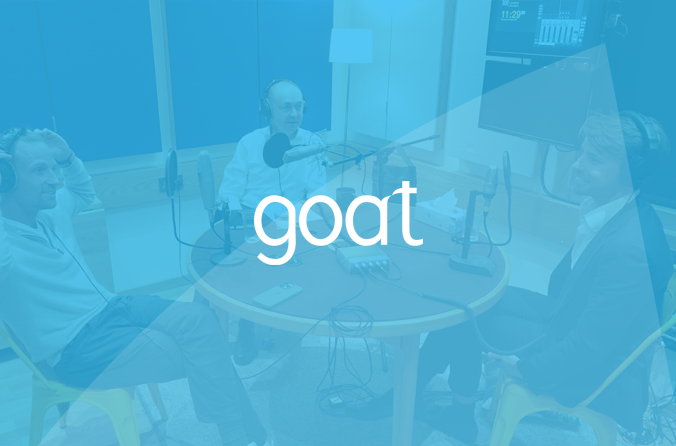
Season 1, Episode 5

Building the world's leading social-first marketing agency

Podcast Image
0:00
0:00 0:00
Download
Audio Transcript

Tim Smallbone

Hello and welcome to Inflexion Point, the podcast that explores those crucial moments in a company's journey that change the trajectory of success. Through conversations with business founders and entrepreneurs, we'll explore what those moments look like and how to recognise and harness them. And in this episode, we'll speak to one of the founders of the GOAT Agency, a business that's grown from three guys with a big idea into the world's leading social media and influencer marketing agency.

Arron Shepherd

Fundamentally, we started on the biggest optimisation of the influencer market that still has ever been done, using over a quarter of a million talents all over the world, testing what their audiences do.

Tom Pemberton

What we saw as the massive opportunity that the guys were already executing on was they'd been doing it for a long time and they had this brilliant flywheel. The more campaigns they were doing, the more data they were collecting, the better they were understanding how to get really great client outcomes.

Tim Smallbone

I'm Tim Smallbone and in my 20 years as a partner at Inflexion, I have been lucky enough to witness a huge number of Inflection points that are part of every success story. The GOAT story is fascinating. Founded by three colleagues who met while working for a social media network in 2012, they quickly realised that online creators were essentially a new media channel. Believing this would be the next big thing for brands, they took a leap of faith and founded the GOAT Agency in 2015. Today, GOAT has 350 employees, has delivered award-winning social and influencer campaigns in over 70 countries and in 38 languages. And earlier this year, GOAT was sold to the world's biggest advertising company, WPP. I'm delighted to welcome one of the co-founders, Arron Shepherd, and Tom Pemberton, an Inflexion partner who sat on the board and worked closely with the GOAT team during our two-year partnership. Welcome to you both, and thanks for joining us. Arron, I wonder if, first of all, you could explain the difference between a social media agency, which is what you were doing before, and GOAT and the influencer marketing agency.

Arron Shepherd

Sure, so influencer really is the distribution mechanism of social, right? If the audiences are in social, the question is how do we get to them and how do we get them to care and act? And the answer to that question is use influencers. Fundamentally, what influencers do is harness peer recommendations. And peer recommendations have always been the most powerful form of advertising. It's just been very difficult to harness that at any form of scale. With the uplift in social and then the increase in the amount of influencers, all of a sudden every niche, no matter whether it's mortgages or beauty products or golf, whatever it is, there's communities of people talking about it online. And then there's communities of audience that segment themselves around that. It's impossible for me to watch half an hour of beauty content accidentally. I'm not interested in it. So you could watch BBC One and then a show come on that you're not really interested in and you keep watching it, but on social, it doesn't work like that. You know, fundamentally, the background of the agency Sport Lobster was a sports social network. So we were really client side, right? Trying to understand how we could grow Sport Lobster as a social network.

Tim Smallbone

This is what you were doing before you founded?

Arron Shepherd

Exactly. So I founded Sport Lobster in 2012, exited in 2015. Harry and Nick, my 2 co-founders at GOAT, both worked for me at Sport Lobster. And really it was my first foray into advertising, right? Prior to that, I'd actually lived in Dubai for four years working in real estate development across Africa. I'd spent nine months living in Nigeria and spent a lot of time in Ghana, Angola, Kenya, Tanzania, etc., setting up offices there. So I'd never really had this advertising experience. And at the time in the early 2010s, it looked like the big social networks were going to go niche. So the whole concept for Sport Lobster is a one-stop shop for sports fans. And then the real core objective for us was how do we onboard users into it, right? We got to two and a half million active users and started to have some success around it. But the fundamental model in advertising tends to be an environment where people spend your money, they come back to you and they go, well, you know, it was okay, but it didn't really work as well as we thought. No one really takes any responsibility. But we were using the agencies and found that the experience was quite disappointing. So started to look at in-housing things ourselves. The first big success we had that sort of the first inflection point really at Sport Lobster was around celebrity ambassadors. So we recognised that in 2012, 2013, some of the biggest sports stars in the world had started to build really significant social followings, but that they weren't monetising it, right? Every deal they did at that point was the same deal they'd done for 25 years, which was OK, we want to do a deal with Cristiano Ronaldo. What does that look like? Three days filming. We're going to make a TV ad. We're going to put images across billboards all over the world. We're going to run it programmatically, except that was the deal, right? They go and pay him 5 million to go and do that. But they'd also started to build significant social followings. And at the time, early 2012, Cristiano Ronaldo had 110 million followers. If he can post about us on that channel, I wonder what the impact will be. So we went to Cristiano first. And we ended up doing an unbelievable deal with him. It was £200,000 that converted into equity for 52 social posts over a year. Now today, Cristiano would charge probably 3 million a post, right? And we're getting it for, 2 grand. He started posting for us, started to generate some decent results. And we thought, okay, here we go. We've found this new way of doing things. So went and got about 500 big sports stars, NBA players, Indian cricket players, loads of footballers, etc, etc. All of them pushing their audiences in sport lobster. At the beginning of 2013, Harry, who, as I mentioned, is my co-founder at GOAT, he actually started a football blogging business when he was 15. So had a lot of people he knew on Twitter. And at the time, Influencer didn't mean anything, right? Didn't exist. There was nobody getting paid on social. The biggest creators on the planet had under half a million followers and we're doing it as a hobby. Harry came to me at the beginning of 2013 once we had all these celebrity ambassadors and said, I found this guy on Twitter; he's got 100,000 followers. He said he'll post about us for 10 pounds if we pay him on PayPal tomorrow, whatever it was. And honestly, I thought, this is ridiculous. Like, who's this random kid? Like, we can't just start paying random individuals 10 pound, like it's 10 pounds who will do it, but like in my head I'm thinking, this is not a test that's going to work. The next day that guy posted, he had 100,000 followers and he drove 2,000 downloads and Cristiano Ronaldo from 110 million followers was driving 1800, right? So 110 million followers.

Tim Smallbone

So a tiny unknown guy was wildly outperforming Cristiano Ronaldo.

Arron Shepherd

Wildly! And that was the second inflection point for us, the real light bulb moment where it was like, what? What on earth is this, right? The word influencer didn't mean anything, like none of these things. This was just some kid, right? And we're trying to figure out, okay, how can we go and do more of this? And so... The next month we went and used 100 different creators. They'd never been paid before. None of them had ever been paid before. We're the first people to pay any of these people and were for the next three or four years.

Tim Smallbone

So they were delighted you just came out of nowhere and started giving them money.

Arron Shepherd

They never even contemplated that they could monetise from this, right? It's why it was all 10 pounds. There was no negotiation.

Tim Smallbone

And so you really founded the whole influencer thing?

Arron Shepherd

Founded it, yeah. We just discovered what was going on and then it sort of started to develop. And then by the time everyone else realised, we were like, oh, actually we've been doing this for a while. So found that first experience. Honestly, we're expecting all of them to go and produce 2,000 downloads. We weren't thinking about GOAT. We're thinking we're going to be, well, I'm going to be Mark Zuckerberg pretty quick. Like, if we can get 2,000 downloads for a tenner, we'll be a billion users in no time and like, life's good, right? So we weren't thinking about GOAT. We're just thinking, let's just go and do as much as possible and it'll all grow and we're going to be absolutely laughing here. But actually, the results of that next month and that next 100 that we used, was the real inflection point because 20% of them did it. 2,000 plus downloads, some of them up to 2,800, but 80% fell flat. Delivered us 10 downloads, 20 downloads, 30 downloads. So fine for a tenner, still not bad value, but a huge disparity between people that could really convert their audience and people that couldn't.

Tim Smallbone

So how do you find out why some were working and some weren't?

Arron Shepherd

The honest answer, Tim, is to this day we don't know. right? There is a reality that 80% of influencers don't work. And until you have tested their audience with a reason to act, we don't know. And we've run AI models against all sorts of things to try and map similarities to this, that, and the other. The only way to actually understand who can work and who can't is to use them, right? And so fundamentally, we started on the biggest optimisation of the influencer market that still has ever been done by a factor of probably 10 at this point, right? Using over quarter of a million talent all over the world, testing what their audiences do. That is just a reality for us and it's going to continue to be a reality. We've used 10 times at least more influencers than anyone else on the planet, which means that we've got 10 times more of that 20%. Most influencer agencies haven't even understood that 80% of influencers don't work because they're not data-driven, right? The influencer agencies, most of them have fallen out of PR agencies where those people were doing deals with celebrity talent 10 years ago, and now they're doing deals with influencers. But when they were doing deals with celebrity talent, it was never about conversion. It was never about selling products. This was PR, brand awareness, like that's it. And so now for them, still to this day, it's just PR. It's the same reason to have a TV ad, right? And there's a role for that. But our role is to provide business results for our clients. And because we've come from the brand side, I recognise that ultimately that's all that matters, right? There's a load of KPIs, but ultimately sales go through that business. Now, there are some other core KPIs around sentiment, but all of those things ladder down to business results, right? And if the business doesn't sell more next year than it did this year, there's going to be an issue. And so, we've always understood that ultimately, it's about getting consumers to act rather than getting consumers to see something. Like that's nice and that's the first step of the process, but ultimately, it's about the action at the bottom of the funnel.

Tim Smallbone

So Sport Lobster gave you a unique view, that relationship with Cristiano Ronaldo, that gave you the understanding of how Influencer was going to work beyond the big name and the little name. And from that, you said, we'd say like a media lunch, where the three of you said, to hell with it, we're going to drop Sport Lobster, we're going to completely change our focus on the influencer.

Arron Shepherd

It wasn't as clear-cut a moment as, you know, you could sort of tell in a story of, okay, as soon as we saw that, we decided, we're going to leave Sport Lobster. It was one thing led to another. And then we had that moment, which weirdly was in a Côte Brasserie in High Street Kensington, where we said, okay, this is like, we've definitely got something here. Like, we should go and do this. But I don't think we truly realised what we had at that point.

Tim Smallbone

You were the very first influencer marketer in the world?

Arron Shepherd

I think we were, I'm sure there's other people that would claim they were doing things, but that sort of level, but there was nothing established. And certainly, if you look around at the agencies that are established now, significant agencies that would be our global competitors, all of them started after us, and none of them are as big as us.

Tim Smallbone

And Tom, if I could just turn to you, you head up consumer for Inflexion, was social media marketing something we were actively targeting?

Tom Pemberton

We invest in high-growth brands and we've been speaking to a number of very successful brands and following all of the trends within consumer. Arron talked about it a little bit then, where consumers were spending time. And we saw obviously the emergence of lots of social media channels and also the emergence of very successful marketing by some quite innovative brands at the time using influencers and using social media really well. So, we'd been following that trend for a while. And as investors, we'd looked at many agencies in the past, lots of digital marketing agencies, PPC agencies, and what we found was a lot of those agencies were doing something well, but they didn't have something that we thought was really quite unique. And when we met Arron and Nick and Harry and the rest of the team, what got us really excited and what we saw as the massive opportunity that the guys were already executing on was they'd been doing it for a long time and they had this brilliant flywheel where the more campaigns they were doing, the more data they were collecting, the better they were understanding how to get really great client outcomes and get the best return for the clients. And so, they had just built this massive moat and competitive advantage. So, for us, we just saw the massive growth in the platform in influencer and social media advertising. And then we met a team that had been doing it and been doing it really successfully for a very long time that was hugely backable and wanted to go and build a global business off the back of it. So it was sort of right time, right place.

Tim Smallbone

So you knew enough at that point to know this was something really different when you met Arron and the team.

Tom Pemberton

Absolutely.

Arron Shepherd

Well, one of the big things for us in that first meeting with Tom, James and David, and we literally spent three days prior to that at another PE office who we felt like we were re-explaining everything to, and they just, they're lovely guys….

Tim Smallbone

But, it would have been like meeting me.

Arron Shepherd

Exactly. There's just, there isn't a native understanding, right? And when we met Tom, James and David, and I'm not going to mention the name of the brand, but they'd obviously just gone through a process of looking at a big brand, that brand was fundamentally built from influencers, right? So, we weren't going in trying to explain to Tom, Dave and James, like, you know, influencers is quite a big thing because they were, they'd seen it, right? They'd seen that this enormous brand is spending like 75% of their spend on it. The fact that the guys were so educated on the space meant that when we walked into that room, we felt an immediate sort of connection and understanding of, oh, this will be a hell of a lot easier if we don't have to explain everything three times or explain it once and they go, yeah, we get it. Like, so it's like this, and this. And we're going, yeah, okay, good. Like, it's not that complicated, but if you don't have that understanding of the space, it is this alien world, right? And so certainly from our side, like, having that meeting with these guys who had all that personal understanding, was such a big moment, and we walked straight out of that room and said, that's it, that’s who we're going to go with, before we'd even negotiated price and everything else, we immediately just decided, like this is who we'd rather spend the next few years with, you know, dealing with this. So, it was a big part.

Tim Smallbone

Why were you looking for a partner at that stage?

Arron Shepherd

To be honest, really what it was is someone tried to buy us, right? And we thought we don't want to sell because we've got so much ahead of us, but it'd be nice to de-risk a bit. And actually, what we felt was that by taking some off the table, it allowed us to be much more aggressive. And I think that would have been harder when we had, particularly having gone through COVID to, and we boomed out of COVID, but like I remember COVID happening, all of our clients pausing and thinking, how have I gone in my head from three months ago thinking we've got a great business here to thinking, God, this is there's so much risk here. And we would have got through it, right, no matter what would have happened, even if it had been six months. But it just had a little bit of a sort of, okay, well, let's not get too far ahead of ourselves. And then when we had that other offer, it was a difficult conversation to just think, oh, we're just going to say no to that, to life-changing money. But we have to say no because we know it's worth so much more than this. And I'm so glad we did it because not only did it bring a partner in you guys that helped us really jump up and that I'm sure we'll talk about it, the business grew so much. As soon as you guys came in, it just went like that. And I'm sure a part of that would have happened to an extent anyway, but a big part of it wouldn't, right? And you guys supported us and allowed us to make some significant bets that then came and paid off.

Tim Smallbone

Tom, when you took it on, did you really understand what it could do?

Tom Pemberton

Yeah, we did. I think back to that very first meeting where we spent about three hours with Arron and Nick and Harry, the three founders of GOAT. And we talked about the opportunity and where the guys wanted to take the business. And I remember Nick Cook turning to us probably within 30 minutes of the meeting and said, do you want us to explain how the industry works and how we operate? And our response was, no, we understand that. We know the space well. We've been doing a lot of work. How do we go faster and how can we help you go faster? And we always saw this as a channel and a space that was going to grow. And the GOAT guys had been really leading in the space, as Arron talked about before. And they were just so far ahead of any other player because of the fact that they've been doing it for so long. They've been doing it so well. They've been building the data set. And what we knew was they needed to go faster and they needed help to do that. And so, we focused heavily on where in the business do they need investment. We focused on the data side of the business, the technology side of the business, and then really helping supercharge growth, particularly in the US. And we just saw that they were in this great position coming out of COVID performing really well, but there was massive global opportunity. And that was why we got so excited and ultimately invested in the business.

Tim Smallbone

I'd be really interested to understand from both of you what is happening in the world today and in the world of advertising. And Tom, you identified that there was going to be a switch of spend towards social media. And Arron, you were a leader within that niche of driving more spend specifically into influencer. Has that switch between traditional and new age, is that now complete?

Arron Shepherd

I think we've actually barely scratched the surface and what's going to come with influencers and creators. I think beyond just influencer marketing, the creator economy is the next thing that's coming. And I believe that in five years' time, the top thousand celebrities on the planet will all be YouTubers, right? I'd argue that the top 20 already are, like Mr Beast and people like that, much more powerful than The Rock or David Beckham or anyone of that ilk. When it comes to them asking an audience to do something, 10 times more people will do it if Mr Beast asks them than if David Beckham asks them. So I think there's just a transformation in sort of how media is looked at and still 50% of spend is on TV, even though the audiences aren't spending a huge amount of time there. And there are reasons for that because it is a very good channel, but ultimately, I think we're going to go to 50% of spend around social influencer and we're probably at three, four, five for most brands. And ultimately, that's why WPP have bought us, because they realise that is the transformation job that they need to do. It's about moving as much of this media as possible, not because it's high margin or anything else, because that's where the consumers are. And if you want to drive brand results and business results for the client, you're going to have to go and activate there. So, there's a huge, huge runway still to go.

Tim Smallbone

The sale to WPP came quite a lot earlier than we were expecting. How did that come about? Presumably, did they identify this need? They thought they realised the way the world was going?

Arron Shepherd

Exactly that, yeah. We weren't in market. We had advisors, but just because people were coming to us all the time and, you know, I think Tom probably got a bit, there's probably too many times where I've called him and been like, these guys are hassling us, they want to buy us, or they want to do this. And so we just thought, what, let's go and get GP Bullhound, who we used, who were fantastic. Let's get them in just alongside us so they can deal with all of this stuff. So we just don't have to be distracted. But ultimately, WPP came to us and came knocking. They decided I guess at the middle point of last year that they needed to go and invest heavily.

Tim Smallbone

They couldn't do it themselves.

Arron Shepherd

No, they couldn't do it themselves. They had to go and invest heavily and then went through the market and came to us. Ultimately, WPP are the number one ad agency on the planet. They were always the one at the back of our mind that we felt was the right place for us. We feel like it's the biggest clients and the biggest work and the biggest opportunities. And so, we could have said no to that and kept going and gone an IPO'd and everything else, but we actually thought we might be able to fast forward our growth here by getting plugged into a WPP.

Tom Pemberton

And it's fair to say the business grew enormously during our investment period with a particular focus on Europe, UK, and the US, and then a little bit in Asia. But with the WPP, you get the full global footprint of, I don't know how many offices in the world you probably know, but it'd be hundreds, right?

Arron Shepherd

Yeah, 120,000 people.

Tom Pemberton

Exactly. And you can have that discussion with a large multinational big brand that spends, I don't know, six, seven, eight billion a year on marketing, and they do that around the world. And the GOAT guys are now having discussions to say; we can service you across the globe and help you with your influencer and your social media. And that is another step change beyond where we had taken the business collectively.

Tim Smallbone

What's the next big thing? You were uniquely positioned to spot a massive change. You've got something else up your sleeve.

Arron Shepherd

I think social and the creator ecosystem is here to stay and still has got an enormous, enormous amount of growth in it. We're starting to see creator businesses become multi-billion-dollar brands. And I think that is going to be transformational and it's going to, I think it wouldn't shock me if, you know, of the unicorns that appear over the next 10 years, if 50% of them are creator-led. And there are some great examples. You look at Mr. Beast in the US with Feastables, chocolate brands that, he's just started out of nowhere and plugs on all his channels like that will get bought by Mars or someone for a couple of billion dollars, no problem. And so why isn't a Coca-Cola or a Unilever trying to create those brands? I imagine having 10 million people that will do whatever you say on a daily basis. Like you can sell whatever you want and you're going to make so much money.

Tim Smallbone

Tom, we do lots of deals. This one must have been kind of fun.

Tom Pemberton

Yeah, a brilliant team, a brilliant business, an absolutely outstanding investment from Inflexion's perspective. That is what we love about our job. We get to back amazing businesses and great people, but the best thing is you enjoy their company, and you have a great time doing it. And that was absolutely what happened with the GOAT investment.

Arron Shepherd

And we were supported the whole way through. And like that as an entrepreneur who's had multiple investors previously is not something that's very common. And like the biggest compliment that I can give them, is it’s very easy when everything's going well to be a good partner. But there were also a couple of moments where there were some painful things, and they were a brilliant partner then. And that's ultimately how I judge Inflexion is actually those moments where it didn't go to plan and what happened.

Tim Smallbone

It's been absolutely fascinating. Thank you. Thank you very much for joining me. Thank you, Tom. That's it for this episode. So my thanks to Arron and Tom for joining me. Remember to subscribe to Inflexion Point wherever you get your podcasts so you don't miss an episode. And check out the Inflexion website if you would like to learn more about how we back ambitious business owners and help them to accelerate sustainable growth. Thanks for listening.

About the episode

Inflexion Point tells the story of the GOAT Agency, the business that was doing influencer marketing before the word influencer meant anything, and grew into the world's leading social and influencer agency. Host Tim Smallbone is joined by co-founder Arron Shepherd and Tom Pemberton, the Inflexion partner who sat on the board through the partnership. They reflect on the moments that shaped it: the early deal with Cristiano Ronaldo, the unknown creator with 100,000 followers who outperformed him, the hard truth that 80% of influencers simply do not convert, and the leap from their sports network Sport Lobster into a data-driven agency. Along the way, they talk about building a competitive moat from campaign data, booming out of COVID, scaling into the US, and the sale to WPP, the world's largest advertising company.